Goober Analyzes Music (GAM) - 'andata' by Ryuichi Sakamoto
Link to the song: here [1] Link to the book: here [4]
Recently, I've been getting into a routine for myself. Part of this improvement has involved reading books. Recently, I've picked up this new book that I've wanted to read for a while:
- "What the Buddha Taught" by Walpola Rahula - a book that summarizes the surface-level teachings of Siddhartha Gautama (the Buddha) [4]
I visit a monastery once a year, and this book was generously printed by them for free distribution. It was one of the few books that I found in English there, so I grabbed it.
While reading, I like to listen to ambient music. I happened to find this song ("andata") in one of my old playlists, and I was immediately drawn to it. I'm pretty sure I've listened to it over 100 times on repeat now (after the analysis).
In this blog, I'd like to talk about the technical aspects of the song as well as my own interpretation of it while reading this book.
The Background: "async"
Ryuichi Sakamoto was a popular Japanese composer and musician mainly known for his work in various films such as "The Last Emperor" and "Merry Christmas, Mr. Lawrence" [10]. Outside of his music, he was an activist for environmental and anti-nuclear causes, and he did not shy away from using his platform (and music) to raise awareness. [10].
He actually has his own Wikipedia page and website if you're interested in learning more about him. I would honestly recommend reading it (although a chunk of sources on the wiki are not available anymore).
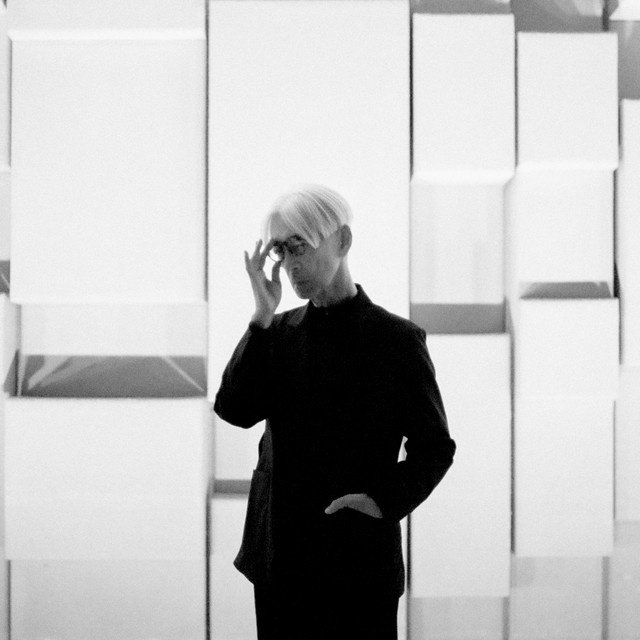
A picture of Ryuichi Sakamoto (source)
"async" was first full-solo album that was released after Sakamoto was diagnosed with throat cancer in 2014 [2]. The album is dubbed as a "score to an Andrei Tsarkovsky film that does not exist" in the way that his films go "beyond music" [5]. While Sakamoto has never explicitly defined his album's theme in this way (as far as I have found...), many people interpret it as a reflection on life, death, and the passage of time. In particular, singer David Sylvian (who read the poem in "Life, Life") described the work as one that "expresses a love and graditude for life accompanied by the knowledge of its fragility" [6]. These set of pieces have many inspirations from Sakamoto's list of favorite composers, including classical composers like Claude Debussy and Johann Sebastian Bach, as well as more modern musicians like John Coltraine and Eduard Artemiev [5][7]. He also had many non-musical inspirations, most of which were related to film and the intersection between sound and image [5][7][9].
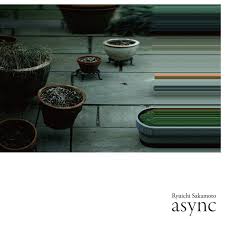
async album cover
In the pursuit of a non-traditional music experience with strange sounds, Sakamoto used many unconventional instruments and objects for the album. While the instruments are not explicitly listed for each song, some general instruments included a pane of glass, pianos that were out of tune and various synthesizers [6][11]. The album clearly uses a lot of field recordings as well as electronic manipulation to create a unique soundscape. Additionally, the unconventional use of "asynchronous" rhythms gave the album an extremely distinct feel.
There's a lot more to say about the whole album (personally, I prefer "garden" and "ubi"), but let's talk about the song that I want to focus on here.
The Song: "andata"
Ironically, "andata" was the only song of the album to be completed before Sakamoto's cancer diagnosis. [6]. I thought it was the one that was most fitting for the theme.
"Andata" is an italian term that - from what I found - means "outward journey" or "gone" [12]. The song itself features a slow piano introduction that gradually evolves into a piece with layered ambient sounds (including synthetic risers, industrial noises, electronic texturing in the form of bass modulation) and a steady chord progression lead by an organ.
The song is in G# minor, and it has a constant time signature of 4/4 with a BPM of approximately 96.
The chord progression itself is mostly as follows:
While the 7th and 9th notes are used interchangebly as the song goes on, this is the basic structure.
However, when the song transitions from the piano intro to the main section, we get a different progression that is only 6 measures long:
This transitional chord progression is repeated multiple times. Each time, new instruments and sounds seem to be introduced.
Here are some basic notes that I found interesting in chronological order:
Click to expand timeline
Feel free to read at your own discretion. I personally listened to this piece on four different audio outputs:
- My laptop's speakers (not too good)
- Beats by Dre - Powerbeats Pro
- Sony - WH-H900N Headphones
- Bose - QuietComfort Headphones
If I missed anything in the ambient noises, please let me know!
I identified the ending chord progression at (3:28) as follows:
This progression is quickly resolved in the end (3:47):
We then have a brief outro that goes to before finally resolving at .
Overall, this song is a rich blend of many different sounds, but it is anchored by a steady chord progression and a slow tempo.
My Interpretation: Loss and Suffering
I - like many others - interpret this song as a reflection on the fragility of life and the passage of time.
To start, there's the title. "Andata", as mentioned earlier, roughly translates to "gone". This - along with the somber tone of the piece - suggests a theme of loss.
The beginning of the song invokes a somber mood. The shifting of sand occasionally moving out of time symbolizes unpredictability and impermanence. Meanwhile, the riser sets up a sense of tension and dread for what is to come. Naturally, the six measure transitional chords (as opposed to eight measures) bring a subtle - yet sudden - shift to the chorus.
The main chord progression possesses a funeral-like quality to it, especially with the organ sound. In it, there is a sense of inevitable despair. However, at the same time, we are not in a void or empty space. The ambient sounds (birds and chirps) remind us that this piece takes place in a world that is still alive. It is almost like walking through a desolate church yard on an partly sunny day. I believe that those note-repeating chirps represent the bask of the sun's rays that shining through but don't provide warmth.
The soft synth that holds the chord at (0:43) (and other places) makes the piece sound more ethereal, reinforcing the idea that the song has to do with things that are deeply intertwined with non-machine, human-exclusive concepts.
Throughout the song, the moving parts (quarter notes) shift between the right and left hand, almost as if they are "dancing around each other". When I learned music classically, I was taught (especially with Bach's pieces) that counterpoint is used to represent two independent voices that "converse". I don't get that sense of conversation here - these sequences of notes feel more like they are circling each other, as they aren't even long enough to be considered a "phrase". This may represent some kind of cycle.
Some of the chirping sounds almost sound like they're "laughing". This could represent memories of a happier time, but they could also sound quite ghastly. On the contrary (or to reinforce, depending on how you see it), the distant yelling sound at (2:13) could represent a cry for help or a scream of anguish.
The bass synth the drones on a note at (2:53) brings a firm sense of death to me. I've seen the use of such sounds before. One example that I can think of off the top of my head is the game "Before Your Eyes" [13]. I don't want to spoil the game, but a similar bass synth is used. In general, the synth can represent the droning or buzzing in your head that takes places with pain and suffering.
Near the end, we get that chord progression at (3:28). Briefly, a sequence is given to us that resolves in a major chord. This brings about a sense of small tranquility before the song ends in the original somber tonic chord.
Overall, I've listened to this song while doing a LOT of things - reading, grocery shopping, even working out. No matter where I am, I always get the feeling of "comfortable dread". I think about the "end" - whatever that means - and the fear of what is to come. However, it should be noted that I have never used the term "sad" to define this piece. I find it to be more reflective and contemplative than anything else.
The Book and Its Connection [4]
(As a disclaimer, I am not an expert in Buddhism, nor am I trying to claim that "andata" is directly related to any religion. I just wanted to see if I could connect my interpretation of the song to something I was reading at the time.)
The connection that I want to focus on is the concept of self and suffering.
In "What the Buddha Taught", Rahula tries to explain the concepts that the Buddha taught (hence the title) in a clear and concise manner despite the language barrier. He explains the Four Noble Truths, and I will provide an insultingly simple summary here:
- (*Dukkha*) Life is suffering.
- (*Samudaya*) The cause of suffering is desire/craving.
- (*Nirodha*) The cessation of suffering is possible.
- (*Magga*) The path to the cessation of suffering is the Noble Eightfold Path.
In this context, suffering is NOT negative. This is heavily emphasized in the book. Suffering can come from three main sources:
- **Physical Pain (*dukkha-dukkhata*)** - the suffering from birth, aging, injury, distress, and all other kinds of physical and mental suffering.
- **Suffering from Change (*viparinama-dukkha*)** - the suffering that comes from impermanence. All good things must come to an end, and this causes suffering.
- **Suffering from Conditioned States (*samkhara-dukkha*)** - the suffering that comes from conditioned existance. This is developed over time.
The first two are easier to understand, while the third one is more abstract. To provide an example, viparinama-dukkha is the suffering that comes from losing a loved one while samkhara-dukkha is the suffering that comes from the realization that you will eventually lose that loved one.
According to these teachings, suffering only ceases when one lets go of desire/craving. However, in order to do this, one has to realize that the "self" is an illusion. The "self" is merely a collection of five aggregates (skandhas): form, sensation, perception, mental formations, and consciousness. Beyond that, there is no "self", as you - these aggregates - are constantly changing throughout your life (and even after death via rebirth). You are not a fixed existance.
(By extension, "karma" - in this context - only applies to volitional decisions that are made by the "self". Thus, "karma" cannot exist if the "self" does not exist.)
This idea of "no-self" (anatta) is crucial to understanding the cessation of suffering. If there is no "self", then there is no one to suffer.
Going back to "andata", we can look at the song as a representation for cyclical suffering. This song does not provide a sense of immediate loss, but rather a slow realization of the impermanence of life and the inevitability of suffering. This does not represent any particular event of suffering - this is what it feels like to exist as a "self" that is bound to the cycle (samsara). This is suffering itself.
Conclusion
Those are my thoughts on the song as well as my janky interpretation of it. After all, this is just a goober analyzing music.
This song has become a staple for now, and I still have to finish reading this book. In the meantime, I do want to explore more music and blog about it on a more consistent basis (it's something I like doing in my free time).
One more time, here's the youtube link to "andata" [1]. Additionally, here's a link to the book [4] if you're interested in checking it out. Cheers.
References
[1] Sakamoto, Ryuichi. "andata." async, Milan Records, 2017. Retrieved Jan 21, 2026. (youtube link)
[2] Hsu, H. (2023, October 21). The beautiful, unpredictable life of Ryuichi Sakamoto. The New Yorker. Retrieved Jan 21, 2026. (article link)
[3] Clear, James. Atomic Habits: An Easy & Proven Way to Build Good Habits & Break Bad Ones. Avery, 2018. Retrieved Jan 22, 2026. (book link)
[4] Rahula, Walpola. What the Buddha Taught. Grove Press, 1974. Retrieved Jan 23, 2026. (book link)
[5] Hubert, Craig (16 July 2018). "Composer Ryuichi Sakamoto Reflects on His Life, Work, and Battle with Cancer". Hyperallergic. Retrieved Jan 23, 2026.(article link)
[6] Beta, Andy (April 21, 2017). "With Cancer in the Past, Ryuichi Sakamoto Returns to His Calling". The New York Times. Retrieved Jan 23, 2026. (article link)
[7] Przybyslawski, Corinne (April 28, 2017). "Ryuichi Sakamoto Survived Cancer and an Earthquake to Make His Most Personal Album to Date". Thump. Retrieved Jan 23, 2026. (article link)
[8] Saxelby, Ruth (July 20, 2016). "Ryuichi Sakamoto Debuts “Raindrops” From His Score For Nagasaki: Memories Of My Son". The Fader. Retrieved Jan 23, 2026. (article link)
[9] Coultate, Aaron (May 3, 2017). "Ryuichi Sakamoto: Everyday objects". Resident Advisor. Retrieved Jan 23, 2026. (article link)
[10] "Biography: Ryuichi Sakamoto". sitesakamoto.com. Kab America Inc. Retrieved Jan 23, 2026. (website link)
[11] Weston, Hillary (June 1, 2017). "Sonic Memories: A Conversation with Ryuichi Sakamoto". The Criterion Collection. Retrieved Jan 23, 2026. (article link)
[12] Cambridge University Press. (n.d.). Andata. In Cambridge dictionary. Retrieved January 24, 2026, from dictionary.cambridge.org (dictionary link)
[13] Gamingtest. (Apr 18, 2021). "Before Your Eyes Full Gameplay". Youtube. Retrieved January 24, 2026. (youtube link)